Call for Papers: Democratic Reversals in Europe and Authoritarian Consolidation in Turkey

The PSA Turkish Politics Specialist Group and the Scotland Network on Turkish Politics invite paper proposals for a one-day hybrid workshop entitled “Democratic Reversals in Europe and Authoritarian Consolidation in Turkey” at the University of Aberdeen (9 October 2026)
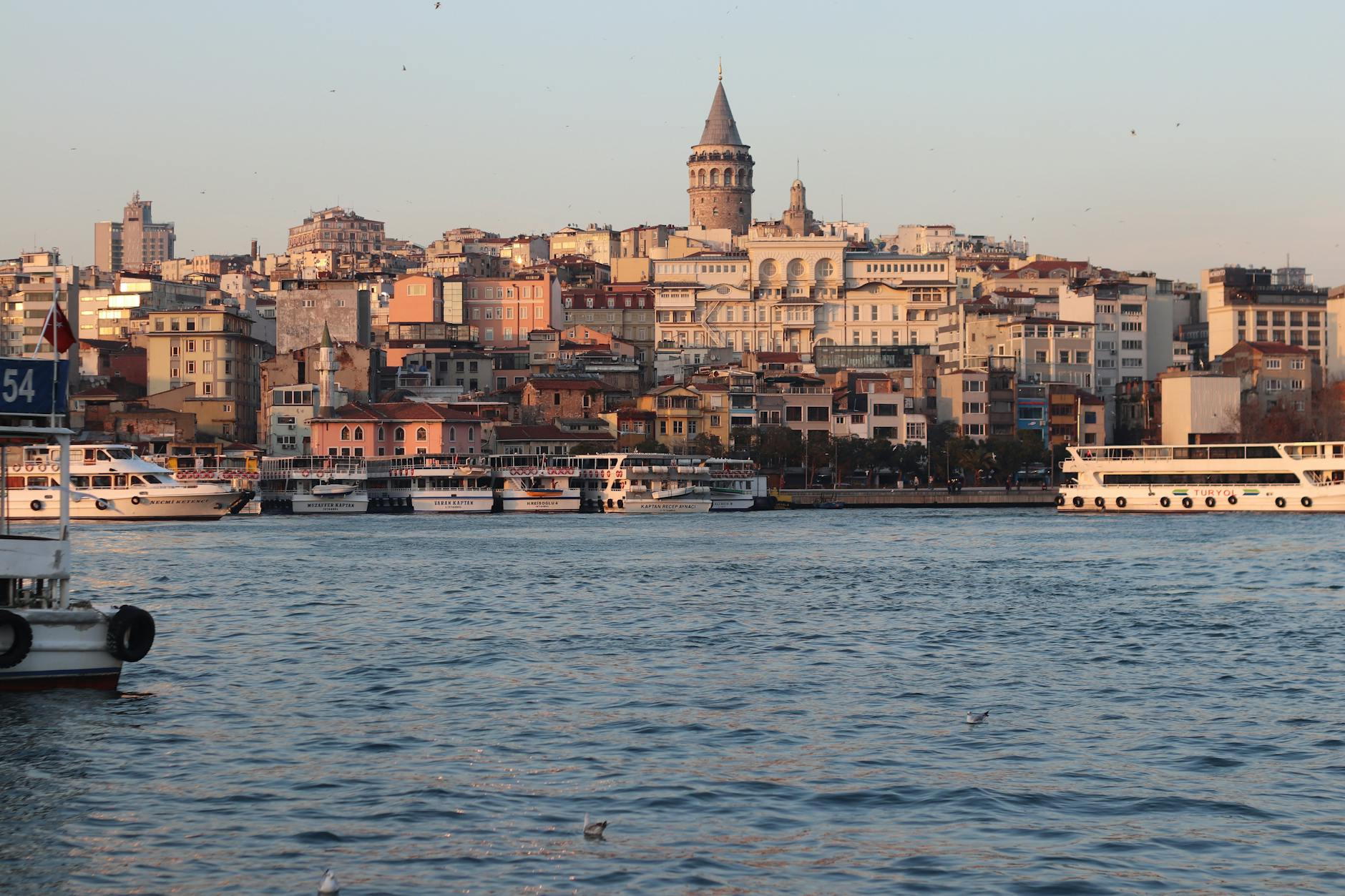
Photo by Cu00e1tia Matos on Pexels.com

The workshop will take place on 9 October 2026 at the University of Aberdeen. Participants will be able to attend either in person or online.

Over the past decade, scholarship on democratic backsliding has increasingly examined whether democratic erosion can be reversed. In Poland, electoral turnover brought to office a government committed to addressing the previous administration’s capture of the courts, media and civil service. Elsewhere in Central Europe, elections have continued to provide an important arena for challenging entrenched incumbents.

Turkey, however, appears to be moving in the opposite direction. Rather than approaching a democratic turning point, it increasingly resembles the consolidated electoral and closed authoritarian regimes of its wider neighbourhood, including Russia, Belarus and Azerbaijan. Although the formal architecture of elections remains in place, the conditions necessary for genuine political competition and alternation in power are being progressively weakened.

Opposition leaders face prosecution, removal from office and political exclusion. Elected municipalities and universities are placed under appointed trustees. High courts and other institutions of horizontal accountability have been hollowed out or brought under political control. Student protests, civic mobilisation and other forms of dissent are met with police violence, criminal proceedings and a dense apparatus of administrative sanctions.

Recent developments further illustrate the intensification of this authoritarian trajectory. The authorities have expanded the crackdown beyond conventional political opposition. Increasingly, the regulation of public space, journalism, cultural production, entertainment, sexuality, protest, and the everyday visibility of dissent has become part of the politics of authoritarian control. Yet, the state propagates a narrative of progress and prosperity, frequently staged through favourable comparison with a Europe portrayed as in decline, that sits at odds with the empirical record.  

The workshop asks what distinguishes Turkey’s trajectory from more reversible forms of democratic backsliding and whether—and under what conditions—democratic reversal remains possible. It invites empirical and theoretical contributions examining Turkey’s movement from democratic backsliding towards authoritarian consolidation, with particular attention to the domestic, transnational and international factors and mechanisms driving this shift. Comparative papers are especially welcome.

Workshop themes

Possible areas of inquiry include, but are not limited to:

Factors and mechanisms of authoritarian consolidation

How are the conditions for alternation in power progressively eliminated? What distinguishes authoritarian consolidation from potentially reversible democratic backsliding?

Lawfare and the opposition

How is law transformed into an instrument for restricting political competition? Papers may also examine how opposition parties and movements organise, adapt and endure when the legal terrain is designed to fragment, constrain and exhaust them.

Repression and its architecture

How is dissent policed and contained beyond the courtroom? Contributions might explore policing, surveillance, administrative sanctions, criminal prosecution, restrictions on assembly and other coercive mechanisms directed at students, protesters, civic movements, universities and civil society organisations.

Propaganda, misinformation and disinformation

How is the information environment controlled, and how are narratives supporting authoritarian rule produced and circulated? Papers might also consider how misinformation and disinformation are used to discredit domestic opponents or target external actors.

Democratic reversal

Under what conditions can democratic recovery occur? What roles can opposition coalitions, local governments, courts, universities, civic movements, professional associations, independent media and diaspora communities play?

The international context of authoritarian consolidation

How do international institutions, geopolitical alliances, economic interdependence, migration, security cooperation and foreign-policy considerations shape Turkey’s democratic trajectory? What forms of external pressure or support remain available to democratic actors and the domestic opposition?

Submission details

Researchers interested in participating should submit:

  • a 250-word abstract;
  • a short biographical statement; and
  • an indication of whether the proposal is for a full paper, presentation or work in progress.

Submissions should be sent to turkishpolitics.scotland@gmail.com by 15 September 2026.

Priority will be given to full papers, although presentation proposals and research in progress are also welcome. Applications will be considered on a rolling basis, and applicants will be notified of decisions as soon as possible.

Organising Committee

Dr Digdem Soyaltin Colella
University of Aberdeen
Convenor, PSA Turkish Politics Specialist Group
digdem.soyaltin@abdn.ac.uk

Dr Aykut Ozturk
University of Glasgow
Convenor, PSA Autocracy and Regime Change Specialist Group
aykut.ozturk@glasgow.ac.uk

Call for Papers: Electoral Authoritarianism and Its Opposition: Turkey, Hungary, and Beyond

The Scotland Network on Turkish Politics invites paper proposals for a one-day workshop on Electoral Authoritarianism and Its Opposition, to be held at Glasgow Caledonian University, Glasgow, on 27 February 2026.

Electoral authoritarianism has become the most prevalent form of authoritarian rule worldwide. At the same time, recent years have witnessed notable opposition breakthroughs and experiments in opposition-led local governance within these regimes, often alongside continued democratic backsliding at the national level.

Prominent examples include opposition-controlled metropolitan governments in Turkey and Hungary, and, most recently, opposition victories in major cities in the United States. Yet these developments have not always translated into broader regime change. In Poland, the Mayor of Warsaw lost the 2025 presidential election. In Hungary, the opposition alliance led by the successful mayor of a mid-sized town failed to challenge Fidesz in the 2022 parliamentary elections. In Turkey, growing opposition influence at the municipal level has instead triggered renewed authoritarian crackdowns targeting opposition-led local governments.

These past and ongoing developments raise important questions about the role and limits of political opposition under electoral authoritarianism. Most importantly, it remains unclear whether, and under what conditions, urban opposition governance can constitute a pathway toward broader political transformation or regime change.

This one-day workshop invites paper proposals that examine the contestation between electoral authoritarian regimes and their opposition, with a particular focus on local politics, urban governance, and opposition-led municipalities.

Possible themes include, but are not limited to:
  • Opposition strategies, organisational capacity, and leadership under authoritarian rule
  • Voter attitudes and support for opposition parties in electoral authoritarian contexts
  • Conditions enabling local opposition victories
  • Urban governance as a site of democratic experimentation and policy innovation
  • Regime strategies and practices targeting opposition-led municipalities
  • The relationship between local-level governance and national-level opposition success

While the call is especially interested in contributions on Turkey and Hungary, it warmly welcomes papers from all world regions and comparative perspectives.

Submission details

Scholars interested in participating are invited to submit a 250-word abstract to
turkishpolitics.scotland@gmail.com by 20 January 2026.

Full paper submissions will be prioritised, but we also welcome proposals for presentations and research-in-progress. Please indicate clearly which format your submission takes. Decisions will be made on a rolling basis, and applicants will be notified as soon as possible.

Limited financial support may be available for scholars travelling within the UK.

Organising Committee

Call for Submissions: Autumn 2025 Turkish Politics Online Workshops by PSA’s Turkish Politics Specialist Group

The Turkish Politics Specialist Group of the Political Studies Association invites submissions for the Autumn 2025 Turkish Politics Online Workshops, co-convened by Dr Aykut Ozturk (University of Glasgow) and Dr Digdem Soyaltin-Colella (University of Aberdeen).

Photo: Digdem Soyaltin-Colella

Turkish Politics Online Workshops are back!

We are happy to announce the call for submissions for the Autumn 2025 Turkish Politics Online Workshops organised by the Turkish Politics Specialist Group of the Political Studies Association (PSA). This online workshop series aims to provide detailed and constructive feedback for working papers on Turkish politics.

We recognize that publishing is essential to secure employment and promotion in academia. Our goal is to provide junior scholars of Turkish politics (PhD students, postdoctoral researchers, assistant professors, or mid-career researchers) with an opportunity to improve the quality of their manuscripts. We are open to all theoretical and methodological approaches to studying Turkish politics, including those from comparative, international relations, or foreign policy perspectives.

We are planning to organize three sessions in October and November 2025. Each sessionwill feature only one paper and last one hour. We expect the applicant to submit a full draft paper at least ten days before the seminar date. During the seminar, the presenter will make a brief presentation about the paper, no longer than 10 minutes. After that, the submitted paper will be discussed extensively by one or two discussants who are experts on the topic, co-convenors of the online workshop, and other attendees. The session will be finalized with a short Q&A session.

Scholars interested in presenting in the Turkish Politics Online Workshops series should send their draft papers to turkishpoliticspsa@gmail.com (Subject: Online Workshop Autumn 2025) by September 21st, 2025. We accept dissertation chapters and pre-analysis plans, as well as manuscripts written in the format of journal articles. We will prioritizemanuscripts that will benefit most from the workshop. 

We will notify the successful applicants by the end of September.

We very much look forward to receiving your applications!

Spring 2025 Turkish Politics Workshop: Join the Discussion

We are pleased to invite you to the Spring 2024 Turkish Politics Online Workshop, a forum for scholarly discussions on key political issues shaping contemporary Turkey. Organized by Assistant Professor Aykut Ozturk (University of Glasgow) and Assistant Professor Digdem Soyaltin-Colella (University of Aberdeen), this workshop is open to all academics and researchers with a focus on Turkish politics. The event will take place via Zoom.

The workshop is structured to provide detailed and constructive feedback on working papers, offering presenters the opportunity to engage critically with both scholars and participants. This collaborative environment is intended to support the refinement and advancement of ongoing research. Each session is designed to foster rigorous academic exchange and encourage interdisciplinary dialogue.

Please find below the programme for our Spring workshop. All of the events will take place at 15:00 UK time.

Meanings/Conceptualization of Democracy: A Political Ethnography in Kirklareli, Turkey
  • Presenter: Cana Tülüs Türk (Sabanci University)
  • Discussants: Begüm Zorlu (City University), Tugce Ercetin (Bilgi University)
  • Date: February 10
  • Registration link

Government Type, Electoral Dynamics, and Subnational Unit Proliferation in Turkey
  • Presenters: Murat Abus (Syracuse University) & Sabri Ciftci (Kansas State University)
  • Discussants: Özge Kemahloglu (Sabanci University), T. Murat Yildirim (University of Stavanger)
  • Date: February 17
  • Registration Link

The Language of Diplomatic Contestation: A Quantitative Text Analysis of Turkey’s Response to EU Criticism
  • Presenter: Lungta Seki (Koç University)
  • Discussants: Senem Aydin Duzgit (Sabanci University), Bugra Gungor (American University of Central Asia)
  • Date: February 24
  • Registration Link

Exploring Syrian Refugees’ Local Destination Preferences: Evidence from Turkey and Germany
  • Presenters: Sefa Seen (Nazareth University), Sevinç Oztürk (Çukurova University), Aykut Öztürk (University of Glasgow)
  • Discussants: Sedef Turper (Koç University), Oguzhan Turkoglu (Hertie School, Berlin)
  • Date: March 10
  • Registration Link

Loyalty or Persuasion? Local Voting Behaviour of Electors in Büyükçekmece
  • Presenter: Murat Oztürk (Istanbul University)
  • Discussants: Aysenur Deger (Syracuse University), Mohsin Hussain (University of Aberdeen)
  • Date: March 17
  • Registration Link

For any queries, contact us via email at turkishpoliticspsa@gmail.com. We are looking forward to a comprehensive discussion and knowledge exchange.

Call for Submissions: Spring 2025 Turkish Politics Online Workshops

We are happy to announce the call for submissions for the Spring 2025 Turkish Politics Online Workshops organised by the Turkish Politics Specialist Group of the Political Studies Association (PSA). This online workshop series aims to provide detailed and constructive feedback for working papers on Turkish politics.

Photo by u015einasi Mu00fcldu00fcr on Pexels.com

We recognize that publishing is essential to secure employment and promotion in academia. Our goal is to provide junior scholars of Turkish politics (PhD students, postdoctoral researchers, assistant professors, or mid-career researchers) with an opportunity to improve the quality of their manuscripts. We are open to all theoretical and methodological approaches to studying Turkish politics, including those from comparative, international relations, or foreign policy perspectives.

We are planning to organize five session in the Spring term.Each sessionwill feature only one paper and last one hour. We expect the applicant to submit a full draft paper at least ten days before the seminar date. During the seminar, the presenter will make a brief presentation about the paper, no longer than 10 minutes. After that, the submitted paper will be discussed extensively by one or two discussants who are experts on the topic, co-convenors of the online workshop, and other attendees. The session will be finalized with a short Q&A session.

Scholars interested in presenting in the Turkish Politics Online Workshops series should send their draft papers to turkishpoliticspsa@gmail.com (Subject: Online Workshop Spring 2025) by January 5th, 2025. We accept dissertation chapters and pre-analysis plans, as well as manuscripts written in the format of journal articles. We will prioritize manuscripts that will benefit most from the workshop. 

We will notify the successful applicants by the 15th of January .

We very much look forward to receiving your applications!

Co-Convenors

Dr. Aykut Ozturk (University of Glasgow)

Dr. Digdem Soyaltin-Colella (University of Aberdeen)

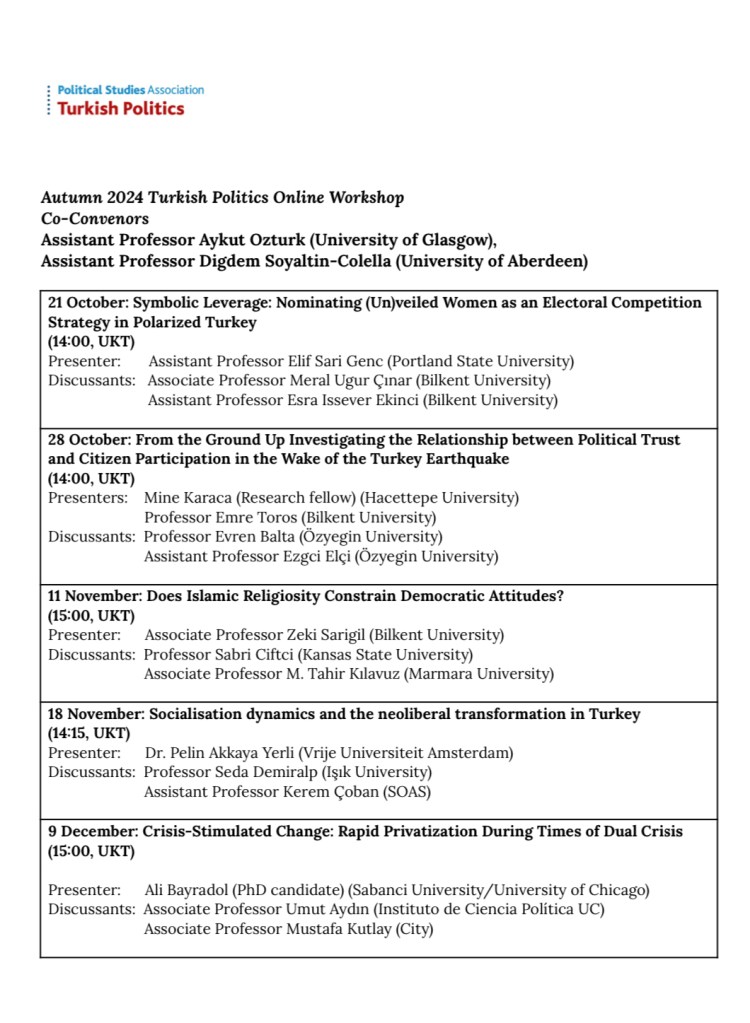
Previous Programme