Call for Papers: Democratic Reversals in Europe and Authoritarian Consolidation in Turkey

The PSA Turkish Politics Specialist Group and the Scotland Network on Turkish Politics invite paper proposals for a one-day hybrid workshop entitled “Democratic Reversals in Europe and Authoritarian Consolidation in Turkey” at the University of Aberdeen (9 October 2026)
Photo by Cu00e1tia Matos on Pexels.com

The workshop will take place on 9 October 2026 at the University of Aberdeen. Participants will be able to attend either in person or online.

Over the past decade, scholarship on democratic backsliding has increasingly examined whether democratic erosion can be reversed. In Poland, electoral turnover brought to office a government committed to addressing the previous administration’s capture of the courts, media and civil service. Elsewhere in Central Europe, elections have continued to provide an important arena for challenging entrenched incumbents.

Turkey, however, appears to be moving in the opposite direction. Rather than approaching a democratic turning point, it increasingly resembles the consolidated electoral and closed authoritarian regimes of its wider neighbourhood, including Russia, Belarus and Azerbaijan. Although the formal architecture of elections remains in place, the conditions necessary for genuine political competition and alternation in power are being progressively weakened.

Opposition leaders face prosecution, removal from office and political exclusion. Elected municipalities and universities are placed under appointed trustees. High courts and other institutions of horizontal accountability have been hollowed out or brought under political control. Student protests, civic mobilisation and other forms of dissent are met with police violence, criminal proceedings and a dense apparatus of administrative sanctions.

Recent developments further illustrate the intensification of this authoritarian trajectory. The authorities have expanded the crackdown beyond conventional political opposition. Increasingly, the regulation of public space, journalism, cultural production, entertainment, sexuality, protest, and the everyday visibility of dissent has become part of the politics of authoritarian control. Yet, the state propagates a narrative of progress and prosperity, frequently staged through favourable comparison with a Europe portrayed as in decline, that sits at odds with the empirical record.  

The workshop asks what distinguishes Turkey’s trajectory from more reversible forms of democratic backsliding and whether—and under what conditions—democratic reversal remains possible. It invites empirical and theoretical contributions examining Turkey’s movement from democratic backsliding towards authoritarian consolidation, with particular attention to the domestic, transnational and international factors and mechanisms driving this shift. Comparative papers are especially welcome.

Workshop themes

Possible areas of inquiry include, but are not limited to:

Factors and mechanisms of authoritarian consolidation

How are the conditions for alternation in power progressively eliminated? What distinguishes authoritarian consolidation from potentially reversible democratic backsliding?

Lawfare and the opposition

How is law transformed into an instrument for restricting political competition? Papers may also examine how opposition parties and movements organise, adapt and endure when the legal terrain is designed to fragment, constrain and exhaust them.

Repression and its architecture

How is dissent policed and contained beyond the courtroom? Contributions might explore policing, surveillance, administrative sanctions, criminal prosecution, restrictions on assembly and other coercive mechanisms directed at students, protesters, civic movements, universities and civil society organisations.

Propaganda, misinformation and disinformation

How is the information environment controlled, and how are narratives supporting authoritarian rule produced and circulated? Papers might also consider how misinformation and disinformation are used to discredit domestic opponents or target external actors.

Democratic reversal

Under what conditions can democratic recovery occur? What roles can opposition coalitions, local governments, courts, universities, civic movements, professional associations, independent media and diaspora communities play?

The international context of authoritarian consolidation

How do international institutions, geopolitical alliances, economic interdependence, migration, security cooperation and foreign-policy considerations shape Turkey’s democratic trajectory? What forms of external pressure or support remain available to democratic actors and the domestic opposition?

Submission details

Researchers interested in participating should submit:

  • a 250-word abstract;
  • a short biographical statement; and
  • an indication of whether the proposal is for a full paper, presentation or work in progress.

Submissions should be sent to turkishpolitics.scotland@gmail.com by 15 September 2026.

Priority will be given to full papers, although presentation proposals and research in progress are also welcome. Applications will be considered on a rolling basis, and applicants will be notified of decisions as soon as possible.

Organising Committee

Dr Digdem Soyaltin Colella
University of Aberdeen
Convenor, PSA Turkish Politics Specialist Group
digdem.soyaltin@abdn.ac.uk

Dr Aykut Ozturk
University of Glasgow
Convenor, PSA Autocracy and Regime Change Specialist Group
aykut.ozturk@glasgow.ac.uk
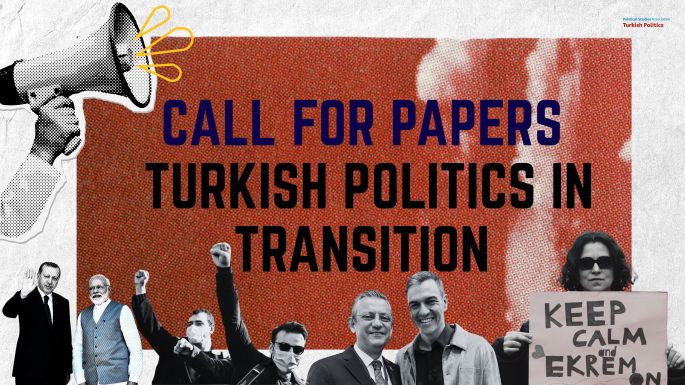
Second Round for Papers: Turkish Politics in Transition: New Perspectives on State, Society, and Foreign Policy

The Political Studies Association’s Turkish Politics Specialist Group invites paper proposals for an upcoming online workshop and a prospective special issue focused on the evolving landscape of Turkish politics.

In recent years, Turkey has undergone significant transformations across political institutions, civil society, and foreign policy. These shifts raise important questions about state–society relations, authoritarian governance, opposition dynamics, and Turkey’s changing role in regional and global politics. This call seeks contributions that critically engage with these developments through innovative theoretical approaches and diverse methodological strategies. We are particularly interested in work that examines the interconnectedness of domestic political change and international dynamics.

Second Round of Submissions

We had shared a call for papers in the summer.

We are now opening a second round of this call for papers, with a new abstract submission deadline of 5 January. We aim to notify applicants of decisions within one week of the deadline and to organise the online workshop in February 2026.

Format and Timeline

The workshop will be held online and will be based on pre-circulated papers. All selected participants will be expected to read each other’s work in advance and to provide comments during the workshop. Our aim is to create a supportive and collegial environment that offers detailed, constructive feedback, with a view to developing papers for the planned special issue, which is scheduled for submission in May 2026.

Please submit an abstract of no more than 300 words, along with a short biographical note, to turkishpoliticspsa@gmail.com.

We warmly encourage submissions from scholars at all career stages and look forward to receiving your proposals.

Scotland to Host Inaugural Workshop on Turkish Politics at University of Glasgow

We are pleased to share the call for papers for the inaugural Scotland Workshop on Turkish Politics, a one-day academic event to be held on 18 June 2025 at the University of Glasgow’s School of Social & Political Sciences. The workshop will bring together early career researchers to present new work and engage in dialogue on contemporary political developments in Turkey.

Organized by a team of scholars based in Scotland and Turkey, the event aims to establish a recurring platform for interdisciplinary research exchange on Turkish politics, with future workshops expected to rotate among Scottish universities. The organizing committee includes Dr Aykut Öztürk (University of Glasgow), Dr Sevinç Öztürk (Çukurova University & University of Glasgow), and Candaş Ayan (Hacettepe University & University of Glasgow).

The call for papers is open until 30 May 2025, with submissions welcomed from doctoral students, postdoctoral researchers, and early career faculty. Accepted participants will be notified by 6 June, and full papers are due by 10 June.

The workshop comes at a time of increasing scholarly interest in Turkey’s political trajectory, marked by democratic backsliding, polarizing populism, and complex shifts in foreign and economic policy. Topics of interest include regime change, digital activism, identity politics, Turkey-EU relations, migration, and more. Both theoretical and empirical approaches across disciplines are encouraged.

The format includes paper presentations with assigned discussants for detailed feedback, a keynote address by Dr Diğdem Soyaltın Colella (University of Aberdeen), and a concluding roundtable on the future of Turkish politics research in Scotland. Dr Soyaltın Colella and Dr Uğur Özdemir (University of Edinburgh) are also confirmed as discussants, with additional names to be announced.

There is no fee to participate, though attendees are responsible for their own travel and accommodation costs. Interested researchers and discussants should send submissions or enquiries to turkishpolitics.scotland@gmail.com.

With its ambition to position Scotland as a hub for critical scholarship on Turkey, the workshop promises to be a milestone for early career researchers and a catalyst for future collaboration across borders and disciplines.

See the full call for papers in the attachment below.

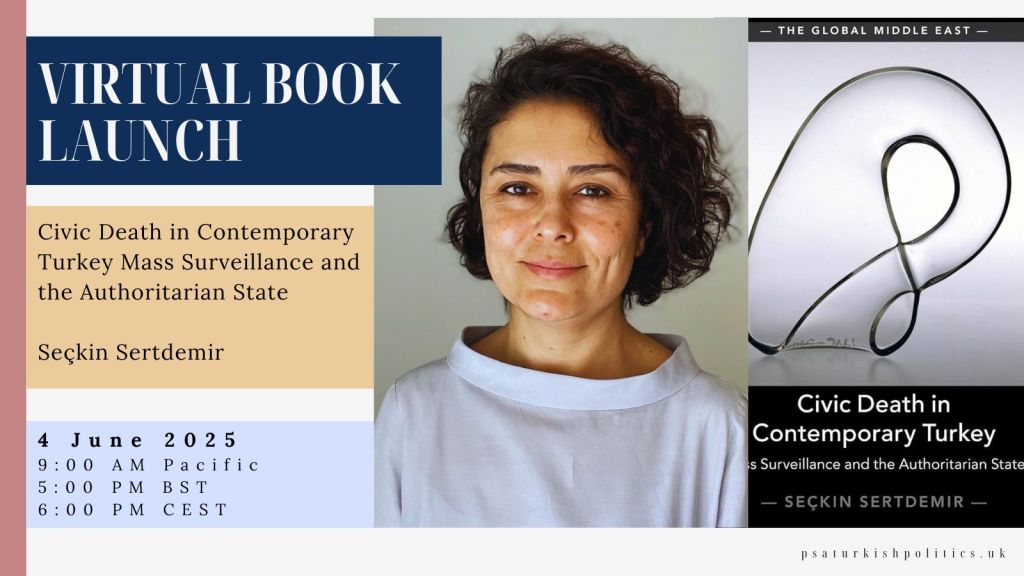
Virtual Book Launch: Civic Death in Contemporary Turkey

We are pleased to invite you to the launch of Dr. Seçkin Sertdemir Özdemir’s new book, Civic Death in Contemporary Turkey: Mass Surveillance and the Authoritarian State (Cambridge University Press).

Dr. Sertdemir Özdemir is a Visiting Fellow at the European Institute of the London School of Economics and Political Science. Her research explores democratic theory and key issues in contemporary political philosophy, including civil disobedience and political rights.

In her book, Sertdemir examines the Turkish government’s response to the coup, which included the dismissal of approximately 152,000 individuals through emergency decrees known as “kanun hükmünde kararnameli” in Turkish. The book explores how these authoritarian securitisation methods were implemented and their impact on the lives of the affected individuals.

The book launch will take place on 4 June at 9:00 AM Pacific Time / 5:00 PM BST / 6:00 PM CEST.


The book will be discussed by Banu Bargu (University of California, Santa Cruz) and Elise Massicard (Sciences Po).

You can read more about the book here.

The event will take place via Zoom. You can find the joining link here.

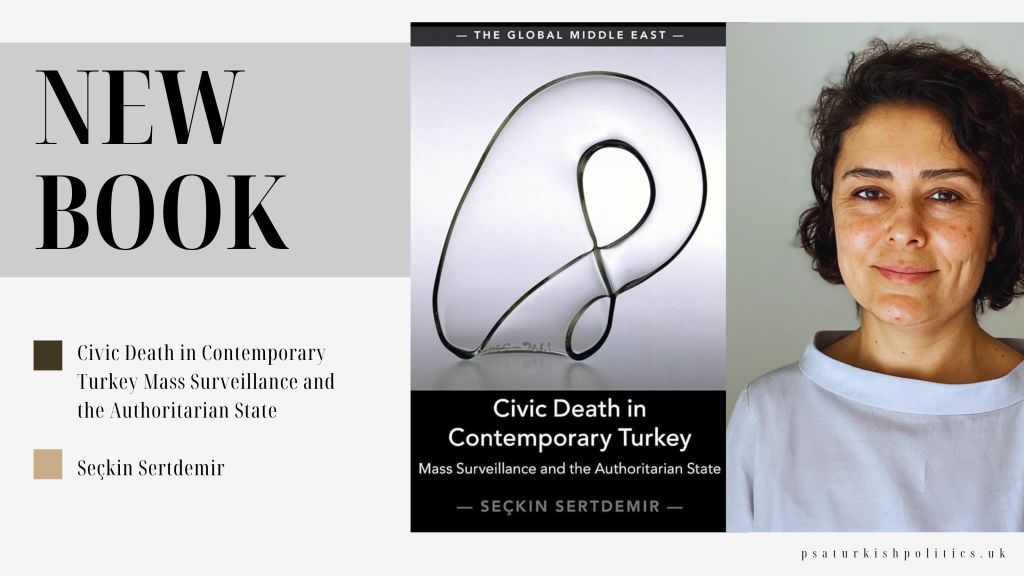
New Book: Civic Death in Contemporary Turkey: Mass Surveillance and the Authoritarian State

We are excited to announce the release of Civic Death in Contemporary Turkey: Mass Surveillance and the Authoritarian State by our colleague Seçkin Sertdemir, published by Cambridge University Press. The study investigates the profound implications of state actions on individual citizens in Turkey following the failed 2016 coup attempt.

In this study, Sertdemir examines the Turkish government’s response to the coup, which included the dismissal of approximately 152,000 individuals through emergency decrees known as Kanun hükmünde kararnameli. The book explores how these authoritarian securitisation methods were implemented and their impact on the lives of the affected individuals.

'Civic Death in Contemporary Turkey' by @seckinsertdemir.bsky.social.Analyses the aftermath of the 2016 Turkish coup attempt, wherein the AKP government introduced new methods of authoritarian securitisation.📚 cup.org/3Wm4vYU 📚

Cambridge University Press Political Science & IR (@cambridgeuppolisci.bsky.social) 2025-01-20T08:35:09.118Z

Sertdemir’s analysis brings together perspectives from political philosophy, social anthropology, and sociology to shed light on the lived experiences of those targeted by these measures. The book also highlights the specific impacts on women, as well as disabled and LGBTQ+ communities.

To read more about the book click here.

*Seckin Sertdemir is a Visiting Fellow in the European Institute at London School of Economics and Political Science.

Join us for the Autumn 2024 Turkish Politics Online Workshop

We are pleased to invite you to the Autumn 2024 Turkish Politics Online Workshop, a forum for scholarly discussions on key political issues shaping contemporary Turkey. Organized by Assistant Professor Aykut Ozturk (University of Glasgow) and Assistant Professor Digdem Soyaltin-Colella (University of Aberdeen), this workshop is open to all academics and researchers with a focus on Turkish politics. The event will take place via Zoom.

Photo by Oziel Gu00f3mez on Pexels.com

The workshop is structured to provide detailed and constructive feedback on working papers, offering presenters the opportunity to engage critically with both scholars and participants. This collaborative environment is intended to support the refinement and advancement of ongoing research. Each session is designed to foster rigorous academic exchange and encourage interdisciplinary dialogue.

The topics covered in the workshop will address significant aspects of Turkey’s political landscape, such as electoral strategies involving the nomination of (un)veiled women, the interplay between political trust and citizen participation in the wake of the recent earthquake, the effects of neoliberal transformations on social dynamics, and the impact of economic crises in accelerating privatization processes.


For further information and dates, please refer to the attached program and see the joining links below.

Joining Links

Please find the registration link for to the presentations below:

11th of November: Does Islamic Religiosity Constrain Democratic Attitudes https://us06web.zoom.us/meeting/register/tZIofu6srT8rGdC5b44HzFOZaWfdzeE78E-1#/registration

18th of November: Socialisation dynamics and the neoliberal transformation in Turkey https://us06web.zoom.us/meeting/register/tZ0tf-mgqj4uHdbur68FS3yo46qvtcIbXQs3#/registration

9th of December: Crisis-Stimulated Change: Rapid Privatization During Times of Dual Crisis https://us06web.zoom.us/meeting/register/tZAlc-yoqzwrE9SezFM8zwZHww1RooTUzCXU#/registration


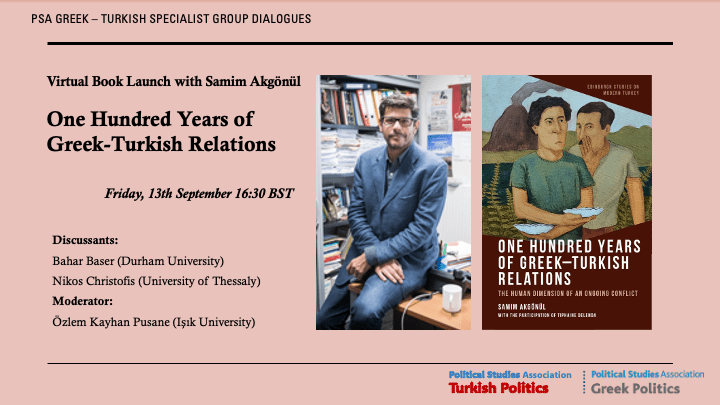
Virtual Book Launch: Exploring a Century of Greek-Turkish Relations with Samim Akgönül

The PSA Greek and Turkish Specialist Groups are delighted to announce a virtual book launch event for One Hundred Years of Greek-Turkish Relations: The Human Dimension of an Enduring Conflict by Samim Akgönül. This event will take place on Friday, 13th September, at 16:30 BST.


The event will feature Bahar Baser (Durham University) and Nikos Christofis (University of Thessaly) as discussants. The discussion will be moderated by Özlem Kayhan Pusane.

To join the event, please register in advance through the provided Zoom link.

PSA Greek-Turkish Specialist Group Dialogues: Analyzing the Post-Electoral Dynamics in Turkey & Greece

The PSA Greek Politics and Turkish Politics Specialist Groups are inviting you to a virtual roundtable to discuss the domestic and international dynamics of the post-electoral context in Turkey and Greece on 20 November 2023 from 16:30 – 17:30 GMT.

The event will host:

Professor Myrto Tsakatika (University of Glasgow)

Dr Özlem Kayhan Pusane (Işık University)

Dr Leonidas Karakatsanis (University of Macedonia)

Dr Buğra Güngör (American University of Central Asia)

The discussion will be moderated by Dr Georgios Giannakopoulos and Dr Begum Zorlu (City, University of London).

Registration can be made via the Zoom link: https://newcastleuniversity.zoom.us/webinar/register/WN_qD658d76RuWl9dNla6Targ#/registration

About the Speakers:

Professor Myrto Tsakatika’s research mainly centers on European Union politics and public policy, with a particular emphasis on exploring the concept of the ‘democratic deficit,’ and shifts in public Euroscepticism. She is also conducting a comparative study of radical left parties, with a special focus on Southern European countries.

Dr Özlem Kayhan Pusane’s broader research and teaching interests lie in the areas of security studies, civil-military relations, counterinsurgency, and counterterrorism. Özlem Kayhan Pusane is also the International Relations officer of the PSA Turkish Politics Specialist Group.

Dr Leonidas Karakatsanis’s research interests include the politics of identity and reconciliation, peace and conflict transformation, nationalism, minority rights, immigration, civil society and the politics of resistance. His theoretical interests include discourse theory, theory of deconstruction, theories of affect, post-structuralist political theory and interdisciplinary approaches to social and political sciences. The area of his research is Turkey and its neighbours in the Caucasus, the Balkans, the Middle East, and the Mediterranean.

Dr Buğra Güngör’s research interests include conflict processes, soft power, public diplomacy, foreign policy analysis, and Turkish foreign policy. He has extensive experience with managing development and humanitarian projects commissioned by various UN agencies, IOs, and INGOs in Switzerland and Turkey. He is also the co-convenor and chair of the PSA Turkish Politics Specialist Group. 

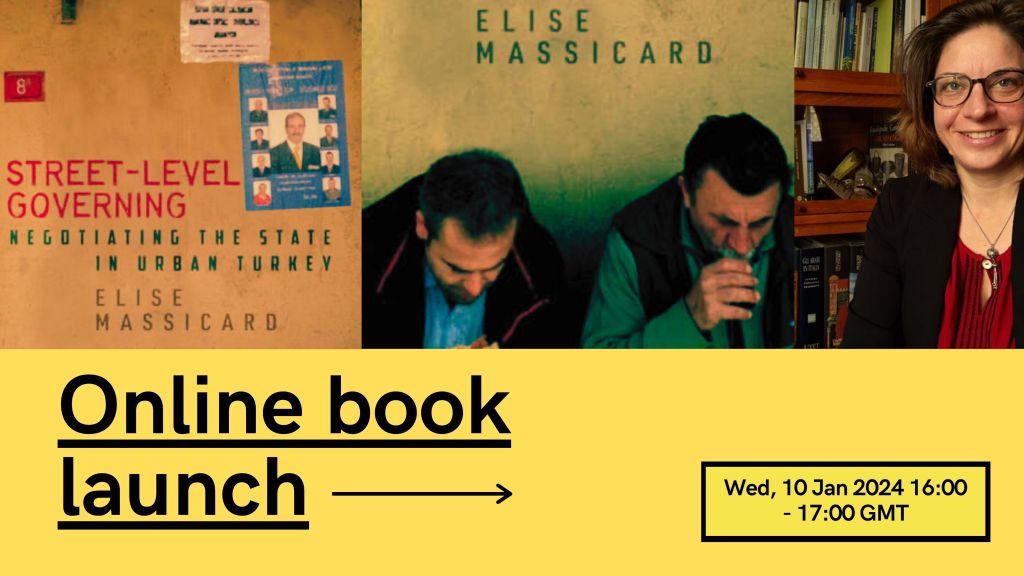
PSA Turkish Politics Virtual Book Launch with Élise Massicard Rescheduled

Due to unforeseen circumstances, the upcoming “PSA Turkish Politics Virtual Book Launch with Élise Massicard” event, originally scheduled for Wednesday, has been canceled.

The event has been rescheduled to take place on Wednesday, 10th January 2024. Please find the updated event details below, adjusted for various time zones:

  • UK: Wednesday, 10th January 2024, at 5:00 PM (17:00)
  • France: Wednesday, 10th January 2024, at 6:00 PM (18:00)
  • Turkey: Wednesday, 10th January 2024, at 8:00 PM (20:00)

For those who have already registered for the event, the registration will automatically carry over to the rescheduled date. We appreciate your understanding and look forward to your participation on the new date.

Workshop Notification: Exploring Turkish Secularism in a Historical Context

In commemoration of the Republic of Turkey’s 100th anniversary, a thought-provoking one-day workshop is set to revisit Turkish secularism in a long durée perspective. This event will trace the evolution of state-religion dynamics in Turkey, beginning with the constitutional inception of secularism and extending to the contemporary discourse surrounding desecularization, particularly during the Justice and Development Party’s governance.

🗓️ Date: 3 October

📍 Location: London

📋 Organizer: Sevgi Adak, (@AKUISMC)

🔗 Registration: https://www.eventbrite.co.uk/e/100-years-of-turkish-secularism-issues-debates-prospects-tickets-689994551277

Admission to the workshop is complimentary, but prior registration is mandatory. You can read more about the event here.