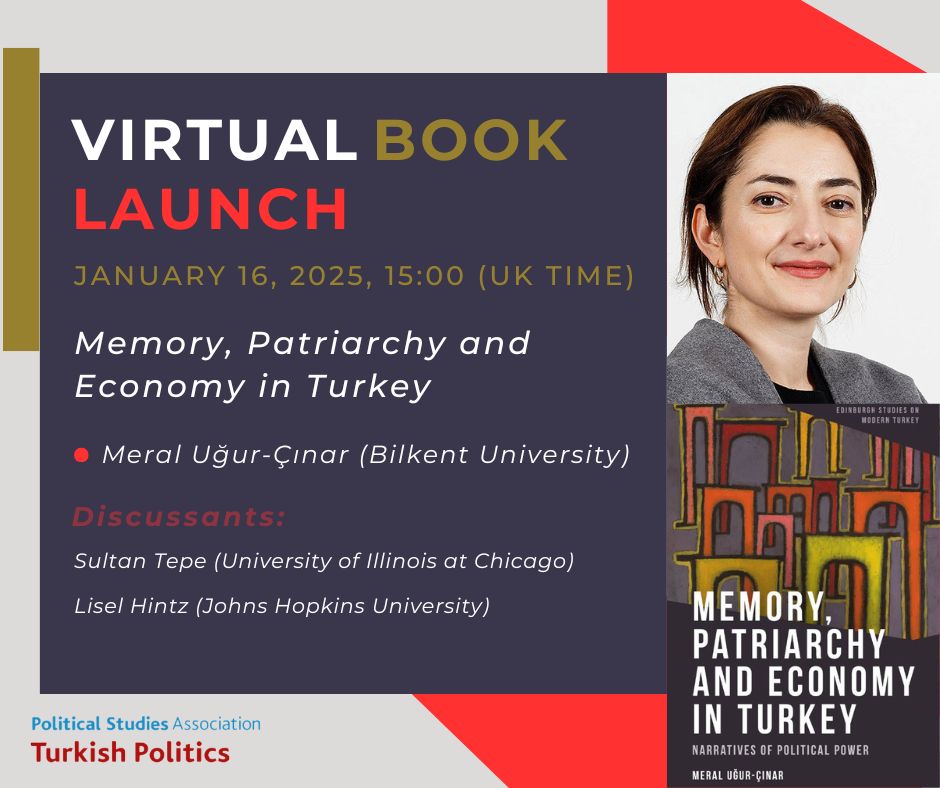
We are inviting you to the online launch event of Meral Uğur-Çınar’s (Bilkent University) book, Memory, Patriarchy, and Economy in Turkey: Narratives of Political Power. The book, published by Edinburgh University Press, investigates the interplay between collective memory, economic development, and patriarchy in shaping political narratives in Turkey.
The launch will take place on Thursday, January 16th at 15:00 (UK time) and will host an engaging discussion in the fields of Turkish politics, collective memory, and gender studies.
It will feature Sultan Tepe (University of Illinois at Chicago) and Lisel Hintz (Johns Hopkins University) as discussants.
We are happy to announce the call for submissions for the Spring 2025 Turkish Politics Online Workshops organised by the Turkish Politics Specialist Group of the Political Studies Association (PSA). This online workshop series aims to provide detailed and constructive feedback for working papers on Turkish politics.
We recognize that publishing is essential to secure employment and promotion in academia. Our goal is to provide junior scholars of Turkish politics (PhD students, postdoctoral researchers, assistant professors, or mid-career researchers) with an opportunity to improve the quality of their manuscripts. We are open to all theoretical and methodological approaches to studying Turkish politics, including those from comparative, international relations, or foreign policy perspectives.
We are planning to organize five session in the Spring term.Each sessionwill feature only one paper and last one hour. We expect the applicant to submit a full draft paper at least ten days before the seminar date. During the seminar, the presenter will make a brief presentation about the paper, no longer than 10 minutes. After that, the submitted paper will be discussed extensively by one or two discussants who are experts on the topic, co-convenors of the online workshop, and other attendees. The session will be finalized with a short Q&A session.
Scholars interested in presenting in the Turkish Politics Online Workshops series should send their draft papers to turkishpoliticspsa@gmail.com (Subject: Online Workshop Spring 2025) by January 5th, 2025. We accept dissertation chapters and pre-analysis plans, as well as manuscripts written in the format of journal articles. We will prioritize manuscripts that will benefit most from the workshop.
We will notify the successful applicants by the 15th of January .
We very much look forward to receiving your applications!
Co-Convenors
Dr. Aykut Ozturk (University of Glasgow)
Dr. Digdem Soyaltin-Colella (University of Aberdeen)
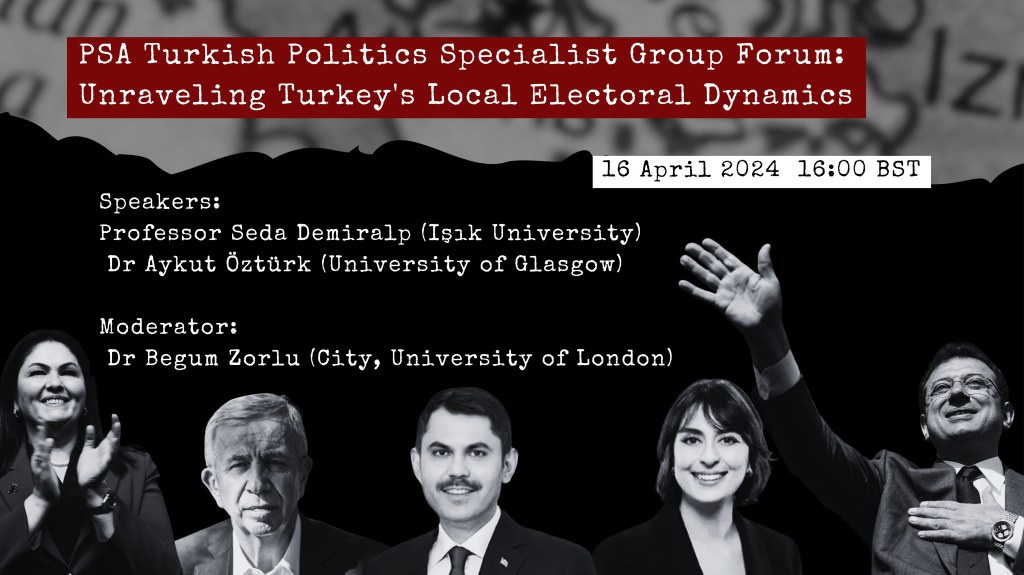
The PSA Turkish Politics Specialist Group cordially invites you to its online forum, where we will analyze the recent local electoral outcomes in Turkey.
The event will take place on April 16, 16:00-17:00 British Summer Time on Zoom.
We will be hosting Professor Seda Demiralp from Işık University and Dr Aykut Öztürk from the University of Glasgow, who will share their insights on the notable victories secured by the main opposition party in key cities such as Istanbul and Ankara, indicating a setback for the ruling AKP government. The presentations will be followed by a Q and A session.
Please find the joining link below.
Topic: Turkish Politics Specialist Group Local Election Forum Time: Apr 16, 2024 04:00 PM London
It is official: Turkey’s presidential election will go to a second round. The two candidates, Erdoğan and Kılıçadaroğlu, differ immensely in their domestic politics. What about their foreign policy outlook? Will the opposition candidate promise to break away from Turkey’s assertive foreign policy? How do international dynamics shape this contentious electoral process?
Our co-convenor Begum Zorlu (City, University of London) has written on the role of foreign policy in Turkish elections for the PSA Blog.
When approached with the question: “what’s foreign policy got to do with the Turkish election” one feels the urge to respond: everything. After 20 years in power, and with international spotlight events like the challenging of the Israeli president Shimon Peres at Davos or comparing German officials to Nazis, Erdoğan and his party dominates the conversation on foreign policy.
Contestatory moves like these are more important than they seem. These statements are the backbone of the incumbent’s populist foreign policy, where the party contests what it labels the “unjust” and “broken” international order, embodied in Erdoğan’s famous slogan “the world is bigger than five”.
The expansion of an injustice frame and how it resonates in the world should not be underestimated.
Followers of Erdoğan around the world voice this vision and have repeatedly underlined that he represents the interests of Muslims around the globe or supports “the voices of the repressed”. This contributes to promoting the incumbent’s framing that without Erdoğan, Turkey’s leadership in contesting injustices domestically and globally will be halted.
The AKP and the International
Under Erdoğan, Turkey has increasingly followed a confrontational foreign policy. However, this has not always been the case. Throughout its first term, along with its acceptance of EU conditionality as part of its desire for EU accession, the AKP used its foreign policy to advance its domestic power. In particular, the AKP came to present itself as a model democratic and Islamic state in the early 2000s. As Cihan Tuğal’s work uncovered, the US was instrumental in promoting what has been termed the “Turkish model”, which resonated with the democracy promotion agenda of the US.
This context changed in the 2010s with the AKP aiming to have an increased influence in the Middle East in the context of Arab Uprisings and increasing authoritarianism at home. After the Gezi Protests of 2013, the AKP adopted a “fifth column[1] frame” to delegitimise the opposition, accusing them of conspiring with international actors. With the 2016 coup attempt, increasing repression had domestic and international consequences. The AKP’s foreign policy took a more interventionist turn, as it directly interfered in multiple conflicts, and ultra-nationalist voices intensified in foreign policy. Turkey’s military intervention in Syria hampered relations with its Western allies and justified the repression of critical voices at home. This is how we came to 2023, with increased domestic and international polarisation. The blocking of Sweden’s NATO membership for example clearly demonstrates the intersection of the domestic and the global. The AKP accused Sweden of harbouring terrorist organisations, highlighting the distinction between friends and foes on both political dimensions.
However, interventionism is not the sole component of the AKP’s foreign policy, and the party argues it follows a competent foreign policy. In their election campaign, the AKP praised that they could negotiate with both sides in the Russia-Ukraine war, make concrete progress such as the grain corridor and prisoner exchange, and keep the possibility of peace on the table. They frame themselves as peacemakers and have used this mediation role to enhance their legitimacy domestically and internationally.
What about the Opposition and Kılıçdaorğlu ?
On the other hand, the political parties that make up the Nation Alliance and Kılıçdaorğlu have been weaker in voicing foreign policy and focused more on domestic issues like Turkey’s economic collapse, democratic backsliding, and justice. When one looks at the electoral manifestos, while foreign policy makes up a small portion of the opposition coalition, it is one of the highlights of the incumbent’s document.
The opposition coalition and their presidential candidate promise a change in foreign policy. Contrasting themselves to the government’s policies, the opposition block’s manifesto claims that they would change Turkey’s foreign policy in the Middle East, respect the sovereignty and territorial integrity of the countries in the region and would not interfere in their internal affairs by “taking sides.” The presidential candidate Kılıçdaorğlu, on the other hand, bridges his domestic call for restoring democracy with his foreign policy outlook. The opposition coalition’s manifesto underlines the dangers of personalisation in foreign policy, and Kılıçdaorğlu states that he wants to follow the democratisation processes promoted by the EU.
What about the stance on Russia ?A couple of days before the elections, Kılıçdaorğlu stated in an interview that if he won, he would bring Turkey closer to NATO and the EU and would be willing to impose sanctions on Russia. He has also accused Russia of releasing fake content on social media and criticised the government for maintaining energy dependency on Russia. This has become an area of contestation between the candidates; as a response, Erdoğan stated that Russia is one of Turkey’s most important allies.
Sevgili Rus Dostlarımız, Dün bu ülkede ortaya saçılan montajlar, kumpaslar, Deep Fake içerikler, kasetlerin arkasında siz varsınız. Eğer 15 Mayıs sonrası dostluğumuzun devamını istiyorsanız, elinizi Türk’ün devletinden çekin. Biz hala işbirlikten ve dostluktan yanayız.
— Kemal Kılıçdaroğlu (@kilicdarogluk) May 11, 2023
While the opposition has a a pro-Western stance, there is also the framing of dignity from the block in their relations with the West. Their manifesto underlines that there should be a “relationship based on equality” with the US. Similarly, in relations with the EU, the opposition block calls for joint responsibility and burden sharing between Turkey and the EU on refugees and notes its intention to review the Turkey-EU migration deal. Therefore, it is not a coincidence that the coalition’s election manifesto has combined migration policies with foreign policy.
From what can be interpreted at the moment, one of the reasons why the six-party opposition coalition is not bold on foreign policy is that this serves as a strategy to hold the group together. The block consists of different voices, from more nationalist to centre-right parties. While Erdoğan dominates the AKP’s foreign policy outlook, the opposition is more fragmented. Also, even though the pro-Kurdish HDP party was not part of the coalition, the cities where Kılıçdaorğlu’s votes were the highest were Kurdish-majority provinces. As the first round of voting demonstrated, without the Kurds’ support, Kılıçdaorğlu cannot be elected.
The nationalist voices in foreign policy are likely to increase whoever gets elected, as the far-right candidate, Sinan Ogan, has received around five per cent of the votes and is critical in determining Turkey’s new president. He recently spoke to Reuters in an interview stating that he would only endorse Kılıçdaorğlu in the runoff if “he ruled out any concessions to the pro-Kurdish party”. Ogan defines himself as the representative of Turkish nationalists and is a staunch supporter of cross-border military operations. He also voices an anti-migrant agenda, arguing that “they will send Syrian refugees by force if necessary”. Therefore the upcoming debates will reflect the anti-migrant and nationalist framing advocated by Ogan and the far-right.
Conclusion
International policy circles are debating the possible scenarios with the two prospective candidates, evaluating whether there will be a break with Turkey’s assertive foreign policy if Kılıçdaorğlu gets elected. The answer is not straightforward, and the international dimension of the election deserves more attention. The AKP’s populism at home is shaped by its global contestatory frames contributing to a boundary between us and them. Especially the construction of the other has been vital in justifying securitisation, as the AKP elites link the political opposition, especially the Kurdish opposition, with foreign threats through a populist framing.
The elections were not free and fair, and as revelations of voting irregularities come in, there are contentious days ahead. If Kılıçdaorğlu gets elected, he promises to decrease the impact of foreign policy on domestic politics and strengthen diplomatic institutions. As stated, Kılıçdaorğlu associates democratisation with enhanced partnership with Western actors, yet the opposition block does not promote a solid and uniform voice on their interpretation of the international order. While the coalition aims to restructure foreign policy and promote a more “rational” foreign policy, the AKP uses the sphere of foreign policy to bolden its injustice frame at home and around the globe. If Erdoğan stays in power, Turkey’s populist and assertive foreign policy will likely continue.
[1] A fifth column is defined as a group or faction of subversive agents who attempt to undermine a nation’s solidarity by any means at their disposal.
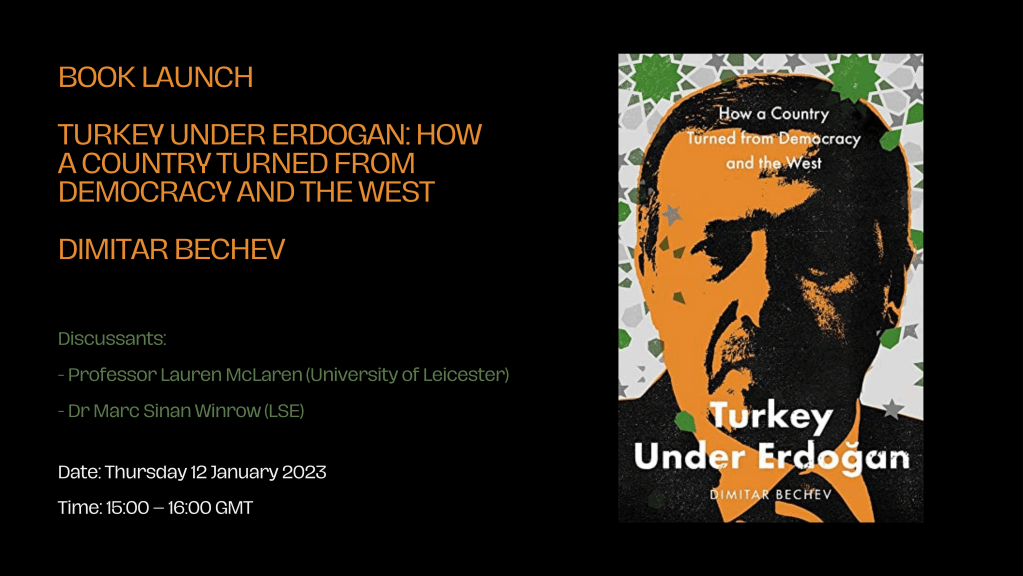
PSA Turkish Politics Specialist Group is inviting you to its virtual book launch event in which Dr Dimitar Bechev will present his new book“Turkey Under Erdogan How a Country Turned from Democracy and the West” published by Yale University Press.
The event will take place on Zoom on Thursday, 12 January 2023, 15:00 – 16:00 GMT.
The book will be discussed by Lauren McLaren, Professor of Politics at the University of Leicester and Dr Marc Sinan Winrow (LSE).
The presentations will be followed by feedback from discussants and a Q&A session.
Registration for the event can be made on Eventbrite.
About the speaker
Dr Dimitar Bechev is a lecturer at the Oxford School of Global and Area Studies (OSGA), University of Oxford.
He specialises in the international politics of Eastern Europe and Eurasia.
Bechev is the author of Turkey under Erdogan (Yale University Press, 2022), Historical Dictionary of North Macedonia (Rowman, 2019), and Rival Power: Russia in Southeast Europe (Yale UP, 2017) as well as co-editor of Russia Rising: Putin’s Foreign Policy in the Middle East and North Africa (Bloomsbury, 2021).
To access more information about Turkey Under Erdogan How a Country Turned from Democracy and the West” click here.
We are sharing the call for papers for the joint panel hosted by Greek Politics and Turkish Politics Specialist Groups at the PSA Annual Conference 2023. The conference will take place at the University of Liverpool, between 3-5 April 2023.
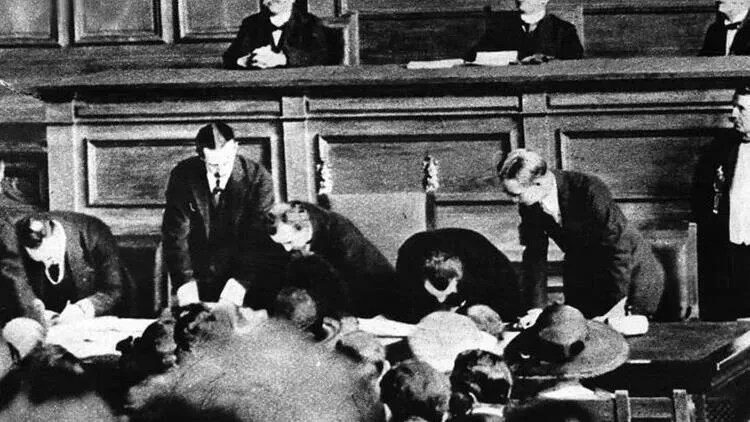
The Greek and Turkish Politics Specialist Groups of the PSA welcome papers for a joint panel, marking the centenary of the Lausanne Treaty in 1923. Taking stock of 100 years of bilateral relations, papers can cover any aspect of state formation in Greece and Turkey and relations between the two nations, including how the history of nationalism and state building impacts relations between the two countries today. Papers with a longitudinal focus covering both Greece and Turkey would be preferred within the general theme of “100 Years since the Lausanne Treaty: Reflections on State-Building, Nationalism and Peace.”
About PSA 2023
The PSA’s Annual Conference 2023 will be held at the University of Liverpool. It plans to combine both in-person and digital presentations. Therefore, we welcome papers which will be presented digitally as well as those which will be presented in-person (please state which format you would prefer in your abstract). Full conference details are available at this link.
Deadline
If you would like to be considered for inclusion in this joint panel, email us a 200-word abstract by the 26th of September 2022 to BOTH email addresses below.
If you have any questions or queries, please do not hesitate to contact us. turkishpoliticspsa@gmail.com v.tsagkroni@fsw.leidenuniv.nl

 PSA Turkish Politics Specialist Group